Monday, April 2, 2012

"Where's Karl?" Contest #1

This is the first installment of the Le Prof et La Potiche Blog "Where's Karl?" Contest!

When we feel like it, we will post photos of Le Prof posing in exciting Mystery Locations in Paris. The Mystery Location will always be a place accessible to the public--no sneaking around inside private backyards and asking you to identify them! The winner of each contest will be the first person to comment, on the blog, by email, or on Facebook, with a correct identification of the location. The person who correctly identifies the most mystery locations by June 30 will win renown and, possibly, if travel funds and luggage space allow, a tiny prize!

Rules:
1. Each individual contest will last one week, or until a winner wins, whichever comes first.
2. If you were with us when the photo was taken, you may not participate in that installment of the contest, though the rest are fair game. That, I'm afraid, is the price of hanging out with us.
3. If nobody wins within a few days, we will post a clue. Or two, maybe.
4. If we decide to issue a prize, it will be of our choosing. Le Radeau de la Méduse will not fit in our luggage, and besides, it is currently on loan.
5. "France" is a correct answer; it will not win you the contest. We reserve the right to determine what is and isn't sufficiently specific.
6. EDIT: You are on your honor not to figure it out with a Google Image search, otherwise there's no point to the contest at all, and nobody will win a tin of prune-stuffed prunes.

Mystery Location #1: Where's Karl?


Answer: the grotto of the Parc des Buttes Chaumont
Winner: Anne!

Le Parc des Buttes Chaumont, a lovely and strange public garden in the 19th arrondissement, opened in 1867. It was previously the site of a gypsum and limestone quarry. You can see where the quarry concept led to.

Commissioned by Napoleon III, it was the work of engineer Jean-Charles Alphand, horticulturist Jean-Pierre Barillet-Deschamps, and architect Gabriel Davioud. The whole project was overseen by Baron Haussmann.


It is extravagantly lovely and bizarre. It undoes all your preconceptions about French gardening. Stalactites!

More pictures available on our Flickr collection, Parc des Buttes Chaumont.


Here is Karl on the bridge to the belvedere of the Sibyl. We didn't see the Sibyl.
See the little folly in the background? That's the same folly seen in the picture above.

Thanks Anne, and thanks to everybody for participating! We will post our next contest at 1 pm EST on Sunday. AND...we will be providing the clue at the same time, so ready your mad research skills now.

Sunday, April 1, 2012

Wheeeee!

Mostly, this blog is about telling you the Real Reason we came to Paris. But this post is about something that took us by surprise.

O Paris! City of cycling amateurs carrying baguettes and avoiding hills! City of old ladies in belted trench coats pedaling sedately to market on bikes, and punks transporting meals for the homeless on bike-wagons, and children and teenagers and college students madly dashing to school on bikes, and old men wearing berets and smoking as they toodle along the river on bikes, and affluent-looking people wearing suits cut better than you'd ever thought you'd see in real life, leaving the stock exchange--on bikes! And everybody else--riding to and from work, running errands, and going out to see friends--on bikes! Who knew?

If you, like La Potiche, are one of those people who learned to ride a bike as a child, but defied all platitudes by managing to forget how to do it, so that, the first time you remounted a bicycle as an adult, you promptly fell off, then got back on and steered sideways right into a shrub, whereupon you fell off again, then gamely got back on, only to find yourself going down a ramp, whereupon you crashed into a railing, fell off, and bloodied your hands and knees--then Paris is the place for you to relearn! There are lots of things about Paris that are not easy for your average American tourist, such as speaking French (my accent has gotten worse. "Bon-JORE!"), finding food on a Sunday (we go out on a massive Friday grocery offensive to equip ourselves till the following Tuesday), and buying stamps anytime ("We have no stamps here," a postal worker told us recently. The three others working the counter all flung their hands in the air: no stamps). But biking in Paris is not one of those difficult things.

They make it so easy here! And it's not for lack of car traffic: there's just good infrastructure.
(left: photo by Pierre Metivier)
This is the Place de la Bastille. It was once a place where Parisians with pickaxes demolished a fortress. Now, it is the place where 11 lanes of vehicular traffic converge on a circle unmarked by any lines. In America, you would be taking your life in your hands to cross that intersection on a bike, but we are not in America, we are in Paris! And in Paris, you just get on your bike and pedal right through the middle of the Place....while the cars, coming at you from ten directions, SLOW DOWN, to let you pass. The first time we saw a bicyclist launch herself into the intersection, we were standing on the curb with our bikes, watching in horror. But she pedaled gaily across, and then another cyclist crossed, and another, and we realized that that was just the way things were here. So the next time we were at Place de la Bastille, it was nighttime....and all the traffic was going faster....but once again, when the light changed, and we pedaled fearfully into the intersection, everybody slowed down to let us go, and nobody beeped, nobody revved his engine to speed us up, nobody flipped us the bird, or, for that matter, nous a fait un doigt d'honneur. In Paris, nobody thinks it's worth killing another person, so you can save ten seconds driving to the gym or the mall.

Almost anywhere else you want to go, there's a bike lane, and when there's not, nobody's going to run you down anyway. Many of the bike lanes in Paris are also bus lanes and taxi lanes: that is, buses are supposed to use them, and taxis sneak into them. When we heard about this, we were all, NO WAY, because we are from New York, and New York buses are ungainly giants that unwittingly crush everything in their wide-turning paths, while taxis want to veer onto the sidewalk, crush pedestrians to death, and park themselves inside restaurant plate glass windows, preferably windows with customers sitting just inside. But in Paris, the bus/bike lanes are wide enough for a bus to come up behind a bike, tinkle the special Pedestrian/Bike bell (which is purposefully gentle and charming-sounding, so that startled cyclists won't veer at the noise), and pass on the left with a margin of several feet. The taxis are similarly well-behaved--and what's more, they yield the right of way to cyclists. It's unbelievable. In two months of city cycling, we have been cut off only once: by a cop car, which made a right turn without signalling, right in front of La Potiche. Let it never be said that bike culture can flourish only in cities that have no motor traffic.

Those of you who knew La Potiche before the recent outbreak of outdoorsiness will not be surprised to hear that she's no athlete. She can only go a few miles before pooping out; she still falls off sometimes; and, going at top speed, she couldn't escape an angry dachshund named Vigo. Which makes Paris a perfect place for her to cycle, and Vélib a great way to do it.

O City of Vélib! Vélib is the Parisian bikeshare program; it gives members unlimited access to bicycles, located all over the city, for short-term use. You can take as many rides as you like, so long as you keep them to 30 minutes (or 45 minutes, if you've subscribed to the Vélib PASSION plan. We have Vélib Passion, oh boy do we ever). If you want to take a long ride, you can ride around for 44.5 minutes--then pop your bike into the lock at the nearest stand--wait three minutes--and take your bike out again! And when you've ridden out to the 47th arrondissement and your legs are tired, no need to make your return trip: just pop your bike into the nearest stand and métro home instead! (If any Americans planning visits to Paris are reading this, note that there are various credit card problems that require you to sign up a few weeks in advance, online, so plan ahead!)

(left: Parc de Bagatelle, Bois de Boulogne)
Did I mention that many of the people biking Paris are far from athletic? One of the funny quirks of the Vélib network is that nobody ever wants to ride up a hill. So Montmartre, which is located, famously, atop an extremely steep hill, has several Vélib stations containing no bikes, because people want to ride downhill (wheee!) but they take the subway back instead, leaving their bikes at a low-elevation rack. However, many of those high-altitude stations award bonus time to people who return their bikes there, as a reward! Le Prof and La Potiche have racked up two Velib+ bonuses so far, without much effort, because most of the bike paths are graded at a gentle incline. The ride up to Montmartre isn't bad at all, if you only take the correct route. (The ride up and over the hill in the Quartier Latin, however, was rather harsh, because unexpected. We rode right by the Panthéon without noticing it, because we were too busy trying not to puke.) But mostly, cycling here is too easy to make anybody puke, unless you're puking from joy that it's springtime and the daffodils are blooming at the Parc de Bagatelle and every single chocolate shop in this city is selling real whole egg shells filled with ganache.

(left: Canal. Bike paths.)
There is only one thing La Potiche likes better than cycling around Paris, and it is messing around with a Sharpie. Here she has started mapping bike trips through the city, but each route only gets marked once, so you can't see how many times she and Le Prof have gone zipping along the Seine path from the Pont Neuf, two blocks from their apartment, along the Left Bank toward the Tour Eiffel. It is a marvelous ride, looking out at the water, the boats, the pollards, the cream, yellow, and gray stone buildings (the Louvre! The Musée d'Orsay! The gold dome of Les Invalides a-glittering in the sun!)--and the freaking Tour Eiffel!!!! It makes La Potiche want to scream WHEEEEEEEEE! but she is trying to blend in. We've gone cycling along the Canal Saint-Martin and Canal de l'Ourcq, and through the crazy crowds at Montmartre, and in a loop around the Arc de Triomphe, and along busy commuter passages to Gare du Nord and Gare de L'Est, and out to double-digit arrondissements to look at cherry blossoms and follies (Parc des Buttes-Chaumont, Parc de Monceau), and through the Latin Quarter, along the gorgeous Rue St-Jacques, past la Butte aux Cailles, and down to the Porte de Choisy to shop in Chinatown and buy banh mi (real baguettes make all the difference). By the time we leave this city, we hope that our bike map will be a crazy black-hatched spiderweb of cycling trips. We've ridden dirt paths along the canals, and cobblestones down Rue Poissonnière, and a good chunk of the Bois de Boulogne, a park two and a half times the size of Central Park and absolutely baffling.

And a highway or two. Last night we cycled home from the Cinemathèque Française, along the ugliest, most desolate bit of bike path we've seen yet in Paris. Once you get out of the park, the bike lanes edge the highway through a commercial/industrial zone that shuts down completely at night. You've seen places like this in American cities, where there are no street crossings for pedestrians because there are no pedestrians, and no stores, no restaurants, no homes or playgrounds: just deserted office buildings and highway. But here, somebody decided that if people wanted to go this way by car, they might, also, want to go by bike, so they built a safe, practical lane. It was an ugly, dark, cold way, but we took it, and saw, ahead of us, other bike lights twinkling along the way.

(right: K biking at Versailles. Because I don't have a picture from last night, because we don't have a handlebar-mounted camera.)
Then suddenly, the path swooped down a ramp, and we found ourselves riding through an outdoor riverside sculpture museum. All along the river, people were walking, sitting around drinking wine with friends, dancing...or cycling. It was startling, coming so soon after the previous dark way, and beautiful in that forceful way that startlingly beautiful things have. We kept saying, "Isn't it amazing?" because we could hardly believe our luck to be living in this city. Cycling is not the reason we came here, but it'll be one of the reasons we'll come back.

Monday, February 20, 2012

The Real, Real Reason We're In Paris

(left: France (?), c. 1460, Man with a glass of wine, detail. Louvre)

Some of you have asked if we have a schedule. Yes, we do! First, La Potiche gets sick. She's on her second cold here. Le Prof writes in the mornings while La Potiche snoozes and sneezes. Once Le Prof routs her out of bed, we go shopping for the day's groceries, which can take anywhere from ten minutes (if we visit the Bio a few doors down), or four hours, if we walk to a new street market. These walks often detour toward churches, parks, and unanticipated confiseurs. Then, somehow, lunch always happens right after the market walk, regardless of whether it was a 10-minute or 4-hour walk: Le Prof eats a hunk of bread and cheese and wine, just like in this painting, and La Potiche eats a quarter of a cauliflower and a jam-jar of yogurt, which is probably in a Flemish still life in the salle of the Louvre that was locked the other day. Then we sit down to write some more (or, for La Potiche, there is a commencement), though, ten minutes later, La Potiche declares, "It's sweetie time!" and routs out whatever candy or pastry we bought earlier that day. Then we really do write. Then we make supper, and afterwards, sometimes we study a little French (Le Prof is trying to master conversational French. La Potiche is trying to master Proust, and elle se fiche de conversational French, because she's going deaf and can't understand anything said to her in English, anyway, and really, what's wrong with spending all your time in Paris alone, wheezing in a cork-lined room? More on that, later). Sometimes, we go out to see parades (two!), and movies (The Artist--more on that, too, later), and friends in cafés.

But the rest of the time, we are busy being Amis du Louvre (Friends of the Louvre)! We paid a membership fee that lets us make as many visits as we want for the duration of our stay in Paris. In the one month and three days we've been in Paris, we've paid five visits to the Louvre, at an average of three hours per visit. Which is to say, we have seen nearly all of the salles on one floor in one wing (Richelieu 2ème), which leaves us two more wings of four floors each. (Correction: and all the rest of Richelieu, of course!) To put this in perspective, we have also visited the following museums/things-like-museums:
--And, most recently, today: the Galérie Saint-German and Réfectoire des Cordeliers, for a gallery show of the work of Lydie Arickx. The Réfectoire is a gorgeous gallery space.

This brings me to a personal revelation, which is what blogging is for. Several years ago, a stranger trying to make smalltalk with me asked, "Do you like art?" And I almost choked on a burst of self-righteous indignation and condescension. What kind of a goon would ask a no-brainer like that? And how on earth could I lump the billions of cultural productions out there under the rubric of art, to be liked or disliked? I have no doubt that I replied in a pretentious, malicious way, then abandoned him to go in search of a cocktail shrimp to commune with on a higher plane.

(right: either a Mayan warrior sculpture, c. 800-1000, or La Potiche's attitude problem. Musée du Quai Branly)

Now, however, I know that there were much better ways for me to respond. Not only friendly ways, but also ways that might have pointed out to me some deficits in my aesthetic sensibilities, and enabled some great changes in my enjoyment of life. Because at that time, the truth was that I didn't like art. I had ideas about art, or rather, prejudices I'd picked up. They had nothing to do with an expansive knowledge of art, and a great deal to do with showing I was the right kind of person, with the right kind of biases, which I wore like the right kind of accessories.

As a result, I didn't like anything that was too "popular" (the Impressionists, or the more floral Van Gogh productions, or anything else that might be represented on a mouse pad). Things made before, roughly, 1880 (like ancient Greek sculpture, or Leonardo's paintings), were to be admired for good form, but otherwise disregarded as irrelevant. (To what? I didn't ask.) Hieronymus Bosch was an exception to that rule, because he was Dark. Good art exposed the Dark Side of the Force, which meant that Goya, Schiele, Van Gogh in a bad mood, Bacon, and anything Japanese was okay; also, agony was good, because it was political, or something. Works made after, roughly, 1930, were also irrelevant, unless they were goth, steampunk, or graphic novels. Colors were to be regarded with suspicion. And having these views didn't mean you actually had to go look at art, because you could just sit in a coffeeshop listening to some cute guy with lots of opinions, and you'd learn all you had to know about Which Artists Mattered. Oh, and Barbara Kruger counted too, because these guys were always Feminists.

(left: The consul Areobindus presides over the games, 506, Constantinople. Cluny Museum)
Then Le Prof, who wasn't yet Le Prof, just this skinny guy (he really was skinny; he weighed 156 pounds with his shoes on) who lived in a walk-in closet in Williamsburg and had somehow read Everything and really enjoyed it all, came into my life. That was when I began to realize that there was something lacking in the way I'd buzz through a museum in search of the Darkest painting in the collection, check it off my list of things to Darkly regard, then head out for coffee. "Oh my god!" Le Prof-Pas-Encore would cry. "LOOK AT THIS!!!!!!" And he'd point at a millimeter-sized detail in some ivory thing from the eleventh century--in a casement, or even a whole room that I hadn't even noticed--and I'd look, and realize that a whole world was contained in the ivory thing, from which Le Prof would spin out anecdotes from books he'd read and other ivory things he'd looked at and books he intended to read but hadn't gotten to yet. And then, after two hours of ivory thingies, Le Prof would want to move on to the Egyptian wing. Or Oceania. Or German Nostalgic Pastoral Works Between the World Wars. Or all the galleries on the Lower East Side. Or all of these and more. It was like Journey; it went on and on and on and o-o-on.... But it was fun. He made it fun to slow down and look.

I'm not sure how much Le Prof realized what a constraint he put me under, to have to look. But it was thanks to him that I realized that I'd divided not just art, but also books and music and film and spectacles and walks and travel and foods and conversations and friends and work, into a narrowly defined realm of the Interesting, and a much wider, undifferentiated realm of the Boring, without having realized that interest is a state of mind in the beholder. I didn't just lack knowledge and experience; I lacked curiosity, without which I could never even realize the aesthetic, intellectual, and emotional boundaries I'd imposed on myself, much less do anything about widening them. What I had to do was to learn To Be Interested. I think that urging me toward that realization, and giving me a living example of how to Be Interested, not just in art, but in lots of stuff, are, by far, the greatest things that Le Prof has ever done for me.
(right: Not dark, and unbelievably gorgeous: Sarcophagus, Sphinx, İstanbul Arkeoloji Müzeleri. That stone is like velvet.)


(left: hard-to-photograph detail from Nicolas Poussin, Triumph of Flora, c. 1627-28)
This is not to say that my taste in or knowledge of art has deepened or improved in a significant way. Rather, in looking more, and liking more, I've only started to glimpse just how much I won't have time to learn or see before I up and die. We have friends who are artists, who are sometimes kind enough to discuss their and others' work with us, and it blows our minds: they know so many things about how to look, and what to look for; their taste is so exquisite; they tell us, "You must see this Poussin show,"or "This is the wrong place to look at Richard Serra," or, sometimes, "This show represents everything that is worst about the art world," about something we've liked, and they make us think. They have a voracious curiosity to make, see, and learn, that is the opposite of the kind of mastery that would claim to have already seen it all, known it all. Art is exciting to me now, not because I've seen it all and know what I like, but for the chance to look at what I don't think I like, and discover why I should; to be astonished by looking at that which I'd never imagined to exist; and to review that which I thought I knew, only to find that I didn't, at all. I enjoy my feelings of ignorance more than I ever enjoyed my pretensions of knowing, because now I'm able to marvel. At beauty! The more things I can find beautiful, the better. I hadn't realized, before, how savorless life was without it.

(left: François Clouet, Elizabeth of Austria. Louvre)
So, the Real Reason we came to Paris was to go crawling through the Louvre and a hundred other museums, looking, very slowly, very carefully at the works, and trying to see what they are. (So carefully that, in fact, when La Potiche was examining a painting of fruit and flowers the other day, she suddenly screamed and bolted backwards into the midst of a tour group. She had spotted a caterpillar. La Potiche really does not like caterpillars.) And if you need any evidence that this was the Real Reason, you need only look at our Flickr galleries. Maybe there is something gauche about being the tourists with the cameras in the Louvre. But it's important to us to be able to revisit, again and again, the things we liked, and to record details of make and date so we can learn more about what we've seen; we also like to share things we think are marvelous and want everybody to see, especially those friends who want to see for themselves but can't get to Paris any time in the near future.

Our galleries are governed by certain constraints, however. We don't keep the many, many photos that inadequately capture what's awesome in a work; the Louvre, in particular, has terrible lighting, and hangs things in such a way that there's always a glare, even when you're standing right in front of a picture. Surveillance systems could learn a lot from their lighting. And we don't often photograph things you can find thousands of images of online, so you won't find La Joconde in our files, unless, by chance, we see something spectacular happening near her, and she just gets in the way. Since Karl's the one who really enjoys taking photos, many of them are related to his research. And when they're not, they're often motivated by a mixture of whimsy and astonishment. And love of cat pictures.
(right: in the category of the utterly rad, from the Entourage of Toussaint Debreuil, Portrait of King Henri IV as Hercules treading on the Lernean Hydra. Louvre. That smirk! Those shorts!)

And Le Prof has a taste for ceramics. He really, really loves a certain kind of ceramic. If you view our gallery from the Victoria & Albert Museum in London, you'll find ceramic upon ceramic upon ceramic. It was our third trip to the museum together, and this was the first time we actually made it all the way through the ceramics wing, though by the end of it we were crying a little, because we just couldn't look at any more ceramics.

There are also dozens or hundreds of things that just made us stop and say, "Wow," and stare, and appreciate. Having a record of all those moments of Wow, counting them up and realizing how many moments of our lives we're devoting to WOW, is reason enough for the project.

(right: Enguerrand Quarton, Pietà de Villeneuve-lès-Avignon, c. 1455, detail of the Magdalene, Louvre. Wow. Holy freaking wow.)
So this is your introduction to our Flickr collections, which contain many images Le Prof couldn't bother to upload to Facebook. As some of you know, we left the U.S. on January 3 and visited friends (and museums!) in London and Istanbul before coming to Paris. You will see that our photos are sorted, conveniently, into art collections and slice-of-life collections. You'll also see that we haven't even gotten around to rotating and labeling some of them. If you don't want to see 3000 pictures of 18th-century ceramics, you don't have to. But I really do think you will be the better for it, because everybody should cry a little at the beauty of the world.

Links:
Our London Collection
Our Istanbul Collection
Our Paris Collection (ever-growing)

Tuesday, February 14, 2012

Happy Valentine's Day From the City of Pentanoic Acid

How to spend Valentine's Day in Paris? The obvious answer was to do what we like best to do with our free time here: to stand by ourselves in out-of-the-way rooms in the Louvre, looking at paintings for hours and not really speaking much. But the Louvre is closed on Tuesdays, so we will have to save our thoughts on art for another post, apart from these two little valentines.

(left: The Triumph of Love, Domenico Zampieri and Daniel Seghers)

(
right, below: Funeral of Love, attributed to Henri Lerambert, c. 1589)

Plan B was hatched two weeks ago, when La Potiche arranged her desk with a cup of coffee, the tin of prune-filled prunes, and the Franck Kestener (a 2003 Meilleur Ouvrier de France Chocolatier*) Atlantique Sablé croquant et caramel tendre à la fleur de sel (the chocolate bar she mentioned before, from Ètoile d'Or: the brown sugar cookie covered with fleur de sel-salted caramel and chocolate), which is the second most delicious candy on earth, to do her and Le Prof's taxes. She'd calculated that their federal income tax refund would roll in just in time for Valentine's Day, so that she could spend the whole thing on Ladurée macarons and tell Le Prof that it was a present for him.


(* Who are the Meilleurs Ouvriers de France, or Best Artisans of France? They are artisans recognized as the best from among 162 trades, including pastry chefs, chocolatiers, denture-makers, bra-fashioners, and lab photographers. Check out the reality show documentary The Kings of Pastry, which, as seen in this trailer, starts to get really fun when the disasters start at the 1:00 mark.)

But, even though the refund has come, we have decided, for reasons we won't go into, because the last thing we need is more vitriol-spewing hate mail inundating our mailbox, that we feel blasé about Ladurée macarons. We would rather spend our €uros on more Franck Kestener chocolate bars, or the box of Breton salted caramels we picked up yesterday for sneaking into the opera.

Yes! Not Götterdämmerung Live in HD, awesome as it was, but something Live in Live! L'Opéra Bastille! How could we spend a winter in Paris and not go to the real live Opera? Well, we did, and we chose Manon, because it was French, and we're in France. What we didn't know about Manon was that there would be a totally appropriate duet that went just like the time that Le Prof said, "What should we do with my leave time?"

And La Potiche replied, "Go backpacking across China for six months! I wanna see Qinghai Lake and the Terracotta Army in Shaanxi and the panda reserve and the Harbin Ice Festival and the Guilin Mountains and the Yunnan rice terraces and hear a Flying Song in Guizhou!" Then she put on her shiny tinfoil hat and started singing a Flying Song, just like this:

La Potiche's favorite song in the world, except for the Rainbow Bread song. She takes every opportunity to link to it.


Anyway, Le Prof said, "You're not planning to do any work, are you?"
La Potiche said, "No way! No siree, Bob!"
Le Prof said, "Uh, I gotta write a thing on The Abyss and a response paper on Skin and a couple talks."
La Potiche said, "Uh. How about Paris, then? You know what they say about Paris: you can write lots of response papers there."


And as it turned out, that's just how this song goes in Manon!

À Paris! à Paris, tous les deux! / Nous vivrons à Paris!
(In Paris! In Paris, the two of us! We'll live in Paris!")

And there's another song, wherein it is revealed that Manon and her boyfriend's apartment has only a tiny little table, and only a single drinking glass for tous les deux! It's just like ours! So anyway, the REAL reason we came to Paris is that, according to some people, you can't write things on The Abyss while you're fighting pandas. Although some other people ask, what is more abyssal, really, than looking into the eyes of a fighting panda? But it's what stranded us here on Valentine's Day, with nothing to do, because Manon happened last night.

After the Ladurée plan hit an epic Fail, La Potiche's Plan C involved buying raw milk crème fraîche and fromage blanc, cooking up sweet onions and chives, and making what would be The World's Awesomest Onion Dip, to go with Lays potato chips. But La Potiche realized that she'd rather save it for a time when she could enjoy her orgy of complete self-indulgence without having to share. When Le Prof heads off to State College, PA this spring to give one of his talks, and La Potiche will be all by herself for three days in Paris...Lucullus will dine with Lucullus.

That left her still pondering what to do for Valentine's Day. What two sexy words come to mind when YOU hear "Valentine's Day?" La Potiche finally came up with...


NECROPOLIS


and

BANLIEUE!

So off we went to la basilique-cathédrale de Saint-Denis. And La Potiche has to say, there was something so romantic in Le Prof's eyes, as he gazed upon the statue of Jeanne de Bourbon (1338-1378) clutching her entrails to her chest, that all her hard work was rewarded.

What's in the Ladurée box?
Why, it's the mummified heart of the Dauphin who would have been Louis XVII! Thanks, honey!

Tuesday, February 7, 2012

Un Autre fourre-tout

Another Grab Bag

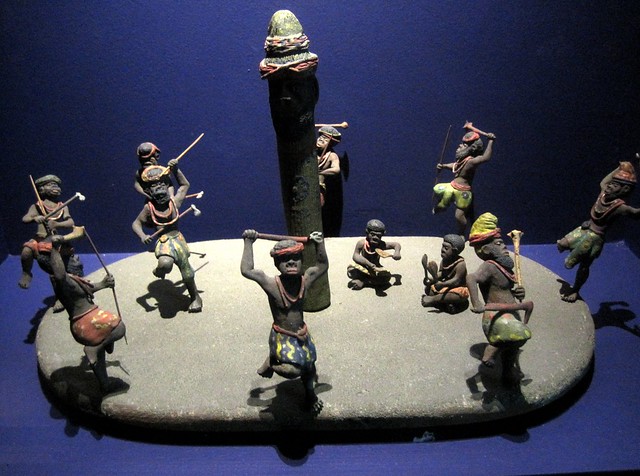
Musée qu quai Branly. Scene of a Kanak dance.

Concerning cramped Parisian apartments, Merritt Symes, Dominic Pettman's wife, remarked that she feels gigantic. Here, the sinks, the lights and all the other household amenities are too close to one another. I feel like she does in this Hobbit-Town. We have outsized hands and bodies. We move, we destroy. The Potiche, though, pretends that she has a perfect lightness, but no one, not even the Potiche, has such little hands.

Not long ago, la Potiche and le Prof visited the Museum of the Quai Branly and saw the show "The Invention of the Savage." La Potiche said to me that she had never seen such a beautiful collection of horrible objects. She has other ideas, below, in the comments. For my part, I wish that the show had as much on interior colonialism as it did on foreign imperialism. The invention of the savage and the invention of France fed each other. Moreover, for Paris, even France was a foreign country.

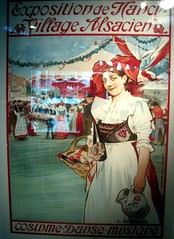
Here you go, a poster that satisfies me:

Musée du quai Branly. Poster, 1909.
It seems to me that Paris also wondered at wooden shoes and Breton head-dresses.

There are more fundamental problems for museums as a whole. It seemed to us that the show condemned colonial ideas and, at the same time, reveled in them. This is a touchy problem for museums: we visit them like tourists; we amuse ourselves; and no matter what horror we see there, we have the pleasure of leisure in them. To see correctly, to make museums more serious, we need more pleasure in our own lives.

A rather silly remark: at the Cluny museum, we saw the show "Gaston Febus (1331-1391) - Sun Prince." I really liked it, but where was his spirit adviser, Orton? Cluny told us stories of hunting and filicide--thanks!--but if a very powerful man has a spectral friend...

One more thing: I am slowly reading The Roads of Paris (1844): the roads before Haussmann! I'm losing myself in it/them. This book is a true treasure. You, reader of Foucault, you know the story of the unspeakable end of Robert-François Damiens. Here are the words of Eugène Briffault on this subject:
Regardless of these grand traditions, the deeds that we just recounted will be a kind of monument to abominable cruelty: they occurred in the era where the French nation prided itself on being the most polished of all. The Era of Louis XIV followed the birth of the philosophy that began to enlighten the world, and it was in this light, before such a people, that we displayed this splendid [or tawdry] ferocity!

Au sujet de l'exiguïté des appartements parisiens, Merritt Symes, la femme de Dominic Pettman, a fait remarquer qu'elle se sent gigantesque. Ici, les éviers, les lumières et toutes les autres installations sont trop près l'un de l'autre. Je me sens comme elle dans cette ville hobbitesque. Nous avons les mains et les corps démesurés. On déplace, on détruit. La Potiche, elle prétend qu'elle ait une légèreté parfaite, mais personne, même pas la Potiche, n’a de si petites mains.

Il n'y a pas longtemps la Potiche et le Prof ont visité le musée du Quai Branly et ont vu l'exposition « L’invention du sauvage. » La Potiche m'a dit qu'il eût la plus belle collection des objets horribles qu'elle n'ait jamais vus. Elle a des autres idées, en bas, dans les commentaires. Moi, je souhaitais que l'exposition exposait le colonialisme intérieur autant qu'il exposait l’impérialisme étranger. L'invention du sauvage et l'invention de la France se nourrissaient l'un et l'autre. De plus, à Paris, même la France était un pays étranger. Voilà, un poster que me satisfait ; il me semble que la Paris s'émerveillait aussi des sabots et des coiffes bretonnes.

Pour les musées, il y a des problèmes plus fondamentaux. Il nous semblait que l'exhibition condamnait les idées colonialistes et conjointement se délectait d'elles. C'est un problème délicat pour les musées : on les visite comme touristes ; on s'amuse ; n'importe quelle horreur on y voit, on y a le plaisir de loisir. De voir correctement, de rendre les musées plus serieux, nous avons besoin de plus de plaisir dans nos propres vies.

Une remarque assez frivole : au Muśee Cluny, nous avons vu l'exposition "Gaston Fébus (1331-1391) - Prince Soleil.” Moi, je l'ai adoré, mais où était son fantôme conseiller, Orton? Cluny nous a raconté les histoires de la chasse et filicide—merci!
mais si un homme très fort avait un ami spectral...

Une chose plus : je lentement lis Les Rues de Paris (1844) : les rues avant Haussmann! Je m'y perds. Ce livre est un vrai trésor. Vous, une lectrice de Foucault, vous savez l'histoire de la fin épouvantable de Robert-François Damiens. Voilà les mots de Eugène Briffault au ce sujet:
Malgré ces formidables traditions, les actes que nous venons de rappeler resteront comme un monument d'abominable cruauté; ils se passaient à l'époque où la nation française se vantait d'être la plus polie de l'univers. Au siècle de Louis XIV succédait l'avènement de cette philosophie qui entreprit d'éclairer le monde, et c'était à ces clartés, a la face de tout un peuple, qu'on déployait ce faste de férocité!

Sunday, February 5, 2012

COLD! And, The Pursuit of Excellence

It's been cold in Paris; at night, it's dropping into the teens, and today it snowed. The streets are glazed with ice; the wind whips down the Haussmannian avenues; and all the piles of dog poop have frozen semi-solid on the sidewalks, which is about as good as you get. Our little space heater runs night and day, and we have taken to wearing long underwear all the time, and for a few days La Potiche had nothing to write for you, because she was busy rereading Dune to keep warm. Even les Français are looking cold: they're wearing two scarves at the same time over their noses, and occasionally covering their glossy hair with HATS. The little dogs are wearing coats but still playing the flâneur, wandering unleashed up and down the sidewalks, browsing shop windows, and completely disregarding their so-called owners who stand shivering thirty meters away, shouting, "Vigo! VIGO!"

On the first day of the cold snap, when the mid-afternoon high was predicted to reach 21, we decided to go for a nearly six-mile walk, the first half all uphill, to a bakery in Montmartre.

Why? Because Pascal Barillon, of the bakery Au Levain d'Antan (which means, roughly, the Sourdough of Yesteryear, which may or may not be a pun on Yesterday's Bread?), won the Grand prix 2011 de la meilleure baguette parisienne (2011 Grand Prize for the Best Parisian Baguette). Jeffrey Steingarten wrote a thrilling account of the first such baguette competition in the '90s, an effort to revive and popularize the traditional baguette, which was being edged out by non-sourdough, machine-made loaves. Last spring, 136 baguettes were entered in the competition, after 38 were eliminated on technical grounds, and Barillon won and will hold the title till next spring.

The best baguette in Paris! Wow! And now you're wondering, how does it compare to lesser baguettes in Paris, such as the worst baguette?

We have seen the worst baguette. It is lurking in the ready-bake stay-puft ziploc bag at the local crap supermarket that smells of rot. As for lesser baguettes, on our first afternoon in Paris, we visited the nearest bakery, one block away, which won the competition the first year and just happened to come in seventh in last year's competition. We took la baguette traditionnelle home and tore it open and put cheese and tomatoes on it (le Prof), and butter and plum jam on it (la Potiche), and devoured it, moaning all the while. It tore apart as easily as Wonder Bread, but was crunchy and flaky and gapped with giant bubbly holes; despite the crunch of the crust, it was feathery inside, but not mushy, not spongy, not insubstantial. And it was TASTY. It was good enough to eat by itself but even better with other delicious things all over it. We ate the whole baguette for lunch, even though La Potiche's throat was raw and the crust made her throat rawer going down, because it was so delicious, so much better than anything we'd called a baguette in the U.S., and it completely validated our sometimes exasperating and exhausting decision to move here.

We've bought many more baguettes from that bakery. They are still good the next day. La Potiche think that they're even better toasted. (Maybe toasting a baguette is a travesty, but if you can make a delicious thing more delicious with a little heat and browning so that it feels like it just popped out of the oven (though sometimes when we get them, they are still warm from the oven!) and it hasn't yet been banned by l'Académie Française.... Now that I've said that, maybe I've branded myself as one of Those People, the ones who prefer red sauce, the ones who like sugar in their coffee.... And now that I've said that, maybe I'd better stop giving up all my claims to having a palate....) We visited another bakery, the 1996 winner and who-knows-what placer in 2011, and agreed that their baguette, while delicious, was not quite as perfect. And we bought some country bread at Poilâne, famous for their country bread, and some more baguettes, and blah blah blah.... Not a day has gone by without its chunks of bread.

Then, last week, when we were foiled in our attempt to visit a street market and were forced to shop for lunch at the gourmet stores along Rue Montorgeuil instead, we dropped into the Maison Kayser, ten minutes away from our apartment, to buy the Baguette Malesherbes.

Ohhhhh la la. We knew it was special even before we'd tasted it, because its crust crackled in a way that was positively electric. As we carried it home, we were afraid of handling it too much and impairing its FORCE FIELD. And then we were home, tearing into it. The Baguette Malesherbes' crust shattered crisply, delicately, into flakes that were almost as light as those old-fashioned Czech glass Christmas ornaments that crumple if you look at them funny.
Its crumb, or mie, had the tenderness of SKIN, as though it were a living animal. It seemed to want to be rubbed against our cheeks (one of us did, and got covered with flour). Its bubbles, stretched thinner than Czech glass, were IRIDESCENT. It seemed to be made of a magic ingredient apart from microbes, flour, and salt. It tasted the way flour is supposed to taste when you're having one of those Amber waves of grain moments, imagining the sunshine and rainwater being absorbed by the wheat and rye stalks. It tasted winily of exhalations of gas and alcohol from the hungry little yeasts, and explosions of sea salt, and the caramel of the sugars in the flour. There are no photos of real baguettes here, because what makes a baguette good cannot be photographed.

(Full disclosure: La Potiche samples a fresh bite of every Kayser baguette, but then she toasts her own portion. The Kayser baguette, toasted, is like falling in love. Kayser baguettes may very well be why the French invented toaster ovens. For that matter, lots of other things we've found here in Paris are totally awesome. Like Le Dustbuster? What a FANtastic idea! La Potiche is going to make her fortune selling the invention to Americans!)

The Kayser baguette was so good that it relegated our neighborhood bakery's heretofore Perfect But Only #7 baguette to "Tasty and completely acceptable when we can't get a Kayser baguette." (Why can't we get a Kayser baguette every day, when Maison Kayser is only ten minutes' walk away? Because sometimes, often, we are coming back from a five-mile march in the opposite direction and are so tired from looking at Art that we cannot force ourselves to take the extra ten blocks out of our way, even for the Kayser baguette.) It was so good that, the other day, La Potiche ordered two baguettes for lunch, and succeeded in eating slightly more than a whole one all by herself. And this got us (her) thinking that we didn't know how Kayser placed in the competition. He may not have entered it; he may have gotten disqualified because his baguettes don't conform to weight and size standards. We knew his baguette was better than #7. We knew it might even be better than the competition winner. But there remained the disquieting possibility that six other baguettes, most especially #1, were better, and we wouldn't know till we'd tasted them.

Hence, the trek to Montmartre, in weather well below freezing, dodging some very slow-moving, gelid crowds, because the Real Reason we came to Paris was the pursuit of excellence. We found the bakery, bought two baguettes, stuffed them awkwardly into La Potiche's bag, because it was so cold that we'd forgotten to bring the roomy shopping bag, climbed a couple hundred stairs to swing by Sacré-Coeur and feel ambivalent about it, and then started heading home, because La Potiche couldn't feel her toes anymore and was afraid of falling down the stairs. Here she is, with a red, windburned face. She is not the Kwisatz Haderach.

But before we'd gone too far, we dropped into a chocolate shop, L'Étoile d'Or (Gold Star), where our friends Rebecca and Rudy once bought us some beautiful chocolate bars stuffed with pistachio paste, because we were still In Pursuit of Excellence.
It was cold in the shop, as in all the other stores we've visited. By the time we'd looked at all the lovely things, and selected a bunch of handmade chocolates, and a tin of prune-stuffed prunes (I do not want to hear your negative opinions about prunes, which add nothing to the conversation), and a chocolate bar made of a brown-sugar cookie covered in layers of salted caramel and chocolate, La Potiche's hands were so stiff that she couldn't handle her money. Luckily, Le Prof still had the use of his hands. Then we marched three miles home, but it was downhill this time.

When we got home, we sat down to eat our lunch of Grand Prix Baguette. It was very good. It was as good as the Kayser. It was exactly as good as the Kayser, apart from being ice cold. And beyond that, we cannot rank it. Because, despite our Pursuit of Excellence, it is simply too early in the game for us. We can tell the difference between a #7 and a #1 baguette, but not between two Top Sixes, or, perhaps, two equally good #1s, as a true connaisseur would. But this impasse is not a dreadful one. We simply have not eaten enough Really Good Baguettes, and we have five more months to educate ourselves. Even if we never actually learn to make those fine, fine distinctions, because our palates will simply not become refined enough--we won't know what to look for, fragrances and flavors will escape us, and our teeth won't sense the tiny differences in crunch and give--it is not a bad thing for excellence, or in this case ignorance, to abound. We can have SEVEN number one boulangeries and live happily, never the wiser.

Here is a picture of one of the candies we bought at L'Étoile d'Or: it is a mandarin pâte de fruit, or fruit jelly, filled with orange liqueur. Reflected in the mirror, La Potiche is having a fit. It came about because Le Prof told her to back away from the candy. His intention was to include her in the photograph. But La Potiche misinterpreted his request as an attempt to keep her from sniffing the candy as closely she would have liked to do at that moment, so she did back off, but then immediately flung herself into a Dance of Rage, which Le Prof captured on his camera. This, friends, is what it's really like here. The Pursuit of Excellence does not extend to Excellence of Character.

And here is my favorite song ever. Like this blog post, it is about excellence and bread. La Potiche likes to dance around the apartment, singing, "Bread! You know that it's...BREAD!" and Le Prof says, "That's not how the words go." But for La Potiche, rearranging song lyrics to suit herself is like toasting: why NOT gild the lily?

And finally, did any of you notice the candy labeled "Pruneski"? It is a dab of sweet prune paste, stuffed inside a date that is dipped into a caramel bath and hardened into golden, sparkling rock sugar crystals...and then dipped in dark chocolate. It is possibly the most delicious candy that has ever been made. If I were a St. Petersburg matron in an unhappy marriage, I would totally fall for a dashing bald officer named Pruneski. But what is a Pruneski? The innerwebs are strangely silent on the subject. We will have to return to the store to find out where these glorious things come from, and how we can get them in New York.

Monday, January 30, 2012

Quelques choses que j’ai appris depuis mon arrivée

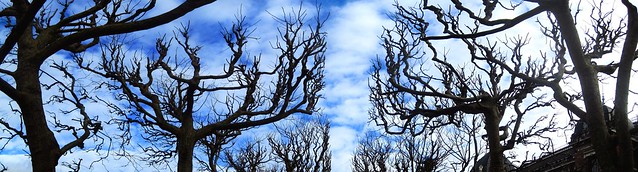
January Trees in the Jardin des plantes


(for why my prose style is so weird, my topics so constrained, and why, for this particular reason, I'm a lot less interesting than La Potiche...and why I've included what looks like a bad French translation, see my first post here)

Several things that I've learned since my arrival:

my words stagger along; my broken-down French stumbles. But I knew this already and you are learning it from this blog. I wanted only to use a handful of the new words that I've just learned;

not too far away, close by the church of St. Germain l'Auxerrois, the Vikings set up camp during one of their ninth-century sieges of Paris;

the same church rang its bell to announce the beginning of the St. Bartholomew Day's massacre...or, I read this but I believe it announced the second day of the massacre. The difference matters only to scholars and to the victims themselves. And in any case, the cruel church was mixed up in the massacre;
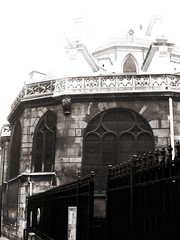
St Germain-l'Auxerrois

in another wonderful book by Graham Robb, Parisians: An Adventure History of Paris (if you haven't read The Discovery of France, add it to your list), I learned that during the 1870 Siege of Paris, the farmers around Paris burned their fields to prevent the Prussians from supplying themselves with provisions. But the fire destroyed only those things on the surface; many things yet survived in the soil. Therefore, the new Republic had the potatoes and other root vegetables that had escaped the fire harvested; to do the job, it invited other farmers, the starving ones, living outside the fertile regions. With full stomachs, these farmers, this plague of locusts, soon returned to their homes. And I imagine that Paris starved more than the Prussians did.

I have a lot of other things about the subject of new ideas and words, but that's enough for now. Soon I'll talk about this show.

Quelques choses que j’ai appris depuis mon arrivée :

mes mots vont cahin-caha ; mon français délabré bronche. Mais je le savais déjà et vous l’apprenez par ce blogue. J'ai voulu simplement utiliser une poignée de nouveaux mots que j’ai appris tout à l’heure ;

à quelques encablures, près de l'église Saint-Germain-l'Auxerrois, les Vikings ont établi un camp pendant un de leurs sièges de Paris au neuvième siècle ;

la même église a sonné sa cloche pour annoncer le commencement du massacre de la Saint-Barthélemy...ou, je l’ai lu, mais je crois qu’elle a annoncé la seconde Saint-Barthélemy. La différence n'importe qu'aux érudites et aux victimes eux-mêmes. En tout cas, l’église sanglante s’est trouvée mêlée au massacre ;

dans un autre livre merveilleux de Graham Robb, Parisians : An Adventure History of Paris (si vous n’avez pas lu The Discovery of France, l'ajoutez à votre liste), j’ai appris que pendant le siège 1870 de Paris, les fermiers autour de Paris ont brûlé leurs champs pour empêcher les Prussiens de se fournir des aliments. Mais les feux n'ont détruit que les choses sur la surface ; encore plus de choses survivaient dans le sol. Donc, la nouvelle république a fait moissonner les pommes de terre et les autres racines comestibles qui ont échappé les feux ; d'accomplir cette tâche, elle a invité les autres fermiers, les affamés, habitaient en dehors des zones fertiles. Leurs ventres rassasiés, les fermiers, cette nuée de sauterelles, ont bientôt retourné à leurs maisons. Et j’imagine que Paris aient affamé plus que les Prussiens.

J’ai beaucoup d’autres choses aux sujets d'idées et de mots nouveaux, mais ça suffit pour le moment. Bientôt je parle à cette exhibition.